
Case Study
Powering Project Approval in Renewable Energy
Strengthening Stakeholder Engagement to Support Large-Scale Energy Development
Context

Develops, builds, owns, and operates power generation, transmission, and energy storage projects across the Americas, Europe, and Japan.

Portfolio includes wind, solar, onshore and offshore projects, long-distance transmission, natural gas, and energy storage.

Rapid expansion of renewable energy infrastructure in the U.S. has increased public engagement and permitting requirements.
Challenges
- Stricter permitting requirements requiring documented, evidence-based public engagement.
- Large, multi-year projects involving thousands of stakeholders across multiple states.
- Legacy stakeholder data spread across systems, limiting historical visibility and context.
- Difficulty maintaining consistent, coordinated outreach across internal teams and external partners.
- Need to manage sensitive information while enabling collaboration at scale.

Solutions
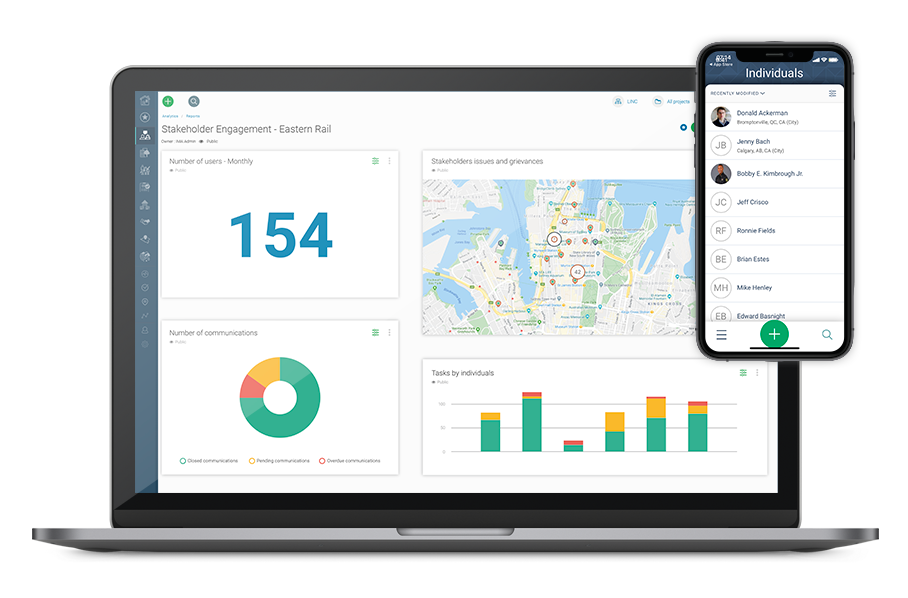
Irth for Stakeholder Engagement, complemented by the Team Data Segregation add-on.
‘‘Being an active and responsible community partner is at the heart of everything that we do. We needed to find an efficient, user-friendly way to track interactions, allowing us to grow relationships with each touchpoint instead of starting fresh each time. By choosing a solution that was fit for us right off the shelf, we’ve saved so much time! We would probably still be testing out other solutions or customizing an internal database right now instead of breezing through it.’’
Associate, Transmission Public Affairs
Key benefits and results
Complete, easily accessible, centralized stakeholder records and engagement history.
Flexible reports on communications, meetings, and outreach activity for faster reporting.
Analytics provide insight into coverage, gaps, and momentum.
Consistent, well-documented engagement supports permitting and public trust.
‘‘We use Borealis (now Irth for Stakeholder management) to keep track of exactly what was discussed with our many stakeholders so that later we can go back and review. This allows us to start a new conversation from where we left off, which supports organic relationship building. Adding notes to a stakeholder’s record – like if they’ve received a local community grant or are a member of a local organization or Chamber of Commerce – helps us engage with stakeholders in a more meaningful and professional way, because we know their interests and what the next step is.’’
Public Affairs Analyst, Power generation development and operations company

Case Study
As Regulations Tighten, Bear Contracting Reduces Risk with Irth’s 811spotter
Heavy civil construction is risky by nature. Underground utilities, tight timelines, changing crews, and unpredictable conditions already create daily exposure for contractors. For Bear Contracting, new regulatory changes in West Virginia added an additional layer of risk — one that forced the company to rethink how it managed 811 tickets across dozens of active jobs.
Bear Contracting operates throughout West Virginia, Ohio, and Pennsylvania, typically managing 8–10 active projects at any given time. Each project requires multiple 811 tickets, and at peak activity, the company may oversee 60–80 tickets simultaneously. When West Virginia updated its 811 regulations — shortening ticket validity windows and limiting ticket distances — the number of required tickets surged. What had once been a manageable administrative task quickly became a growing operational and compliance threat.
For Bear, the challenge was no longer just efficiency. It was risk.
The Situation: Regulatory Change Raises the Stakes
West Virginia’s updated 811 rules significantly reduced ticket lengths to 2,500 linear feet and shortened ticket validity to as little as 10 days. Overnight, ticket volume increased, and renewal frequency accelerated.
The implications were serious:
- Compliance risk increased as tickets expired faster and oversight became harder.
- Safety exposure rose if field crews acted on outdated or incomplete information.
- Administrative overload strained a lean office team already balancing multiple projects.
- Operational bottlenecks emerged as superintendents depended on project managers for real-time clearance updates.
Construction delays, missed renewals, and line strike exposure were no longer theoretical concerns, they were real possibilities.
One incident illustrates the risk. On a sewer project requiring roughly 40 tickets, a single ticket expired without anyone realizing it. Locate marking was delayed, and work had to pause. It wasn’t catastrophic — but it was a warning. As regulations tightened, Bear knew their existing approach would not scale safely.
The Impact: Time Loss, Bottlenecks, and Human Risk
Before making a change, Bear relied on a shared Excel spreadsheet to track every 811 ticket. Each week, project managers manually checked ticket statuses by copying ticket numbers into the state 811 system and updating the spreadsheet — one ticket at a time.
This process alone consumed 2–4 hours every Monday. Beyond that, project managers spent another 1–2 hours per week fielding calls and emails from superintendents who needed to know where they could safely work.
Even more concerning was how information flowed. Critical details from utility companies — such as standby requirements — were often communicated verbally. If a superintendent changed jobs or someone filled in unexpectedly, those details didn’t always transfer. The system depended on people remembering, relaying, and interpreting information correctly — an unnecessary risk in an already high-risk industry.
Bear realized that continuing this way meant accepting avoidable exposure.
The Turning Point: A New Way Forward
While attending an industry conference, Bear’s operations leadership saw a demonstration of 811spotter. The timing couldn’t have been better. The platform addressed the exact pressure Bear was feeling — managing more tickets, under tighter rules, with less margin for error.
Instead of committing immediately, Bear opted for a short trial.
Within days, the team could see how centralizing ticket data, automating updates, and giving both office and field teams real-time visibility fundamentally changed how work flowed.
The Solution: 811spotter Powers a Safer, Smarter Process
With 811spotter in place, Bear shifted from a people-dependent process to a system-driven one.
Instead of project managers acting as gatekeepers, everyone who needed ticket information could access it directly, from superintendents and surveyors to safety and logistics teams. Ticket statuses updated automatically, eliminating weekly manual checks and dramatically reducing the chance of missed renewals.
Most importantly, responsibilities changed:
- Project managers regained time to focus on planning and execution instead of administration.
- Superintendents gained confidence to make informed decisions in the field without waiting on the office.
- Safety and continuity improved because ticket details and utility notes lived in a shared system rather than in someone’s memory.
The Results: Reduced Risk, Faster Decisions, Stronger Ownership
The impact was immediate and measurable.
Time Reclaimed
- 2–4 hours saved every week from automated ticket updates
- 1–2 hours saved per project manager from reduced calls and emails
- Compounding savings across multiple jobs and teams
Lower Risk, Greater Confidence
Since implementing 811spotter, Bear Contracting has recorded zero line strikes on marked utilities. Real-time visibility has reduced uncertainty, minimized delays, and helped crews stay compliant even as regulations tightened.
Empowered Field Leadership
Superintendents now own day-to-day decisions with confidence.
‘‘We’ve implemented a strong sense of ownership with our superintendents, and the last thing we want is the office holding up progress during good weather,’’ said Derek Rogers, Operations Manager at Bear Contracting. ‘‘811spotter empowers our guys to know where they can work, what utilities are in the area, and make smart, confident decisions in the field.’’
Leading the Change Forward
What started as a response to regulatory pressure has become a competitive advantage. Bear Contracting is now leading by example, demonstrating how modern ticket management can improve safety, reduce risk, and support growth.
The company plans to expand its use of 811spotter across projects in Ohio and Pennsylvania, carrying the same disciplined, system-driven approach into new regions. Rogers also plans to share Bear’s experience with industry peers, encouraging broader adoption of safer, more reliable ticket management practices.
For Bear Contracting, 811spotter is the foundation of a smarter, safer way to operate in an industry where the cost of missed details is simply too high.