3 min read
Interested in joining a Private Preview for Geohazards? Contact Us.
Understanding the interaction between pipelines and their surrounding environment is essential for effective integrity management. Slope instability, seismic activity, flooding, and soil movement can all impose external stresses that compromise pipeline performance and safety. Historically, these environmental datasets have existed in isolation from integrity systems, limiting an operator’s ability to assess how external conditions influence pipeline integrity.
Moving Beyond Isolated Datasets
Historically, environmental datasets and integrity systems have evolved independently. Operators may have access to high-quality geotechnical or environmental data, but these datasets are often reviewed in separate tools and workflows. As a result, identifying where environmental hazards intersect with pipeline conditions is a manual, time-consuming process.
A key driver for this work was collaboration with operators managing pipelines in diverse, high-risk environments.
SMUD operates gas pipelines in regions exposed to seismic activity, slope instability, and wildfire risk. Their team needed a more efficient way to correlate environmental hazards with integrity data and understand where those threats intersected with pipeline assets. Their focus was on consolidating data sources, improving visibility, and enabling faster identification of areas of concern. This led to early work on integrating external datasets, such as seismic, slope, and fire data, with pipeline alignment and evaluating those conditions against asset location.
A South American pipeline operator and current Irth client faced a related challenge from a workflow perspective. Their team was spending significant effort manually reviewing geohazard information across multiple systems and translating that into actionable insights. The need was less about access to data and more about structuring how that data could be evaluated consistently. Initial work focused on defining user workflows for identifying geohazard-prone locations, tracking observations, and improving site prioritization for further investigation.
These use cases reinforced the same core problem: the data existed for assessing geohazards, but it was not connected in a way that supported efficient decision-making.
What We Built in Phase I
The initial phase of the Geohazard Management module focuses on integrating and visualizing data.
Key capabilities include:
- ROW inspection data integration
Field observations can be brought into the system and aligned spatially with the pipeline, allowing inspection findings to be reviewed in context. - Bending strain visualization
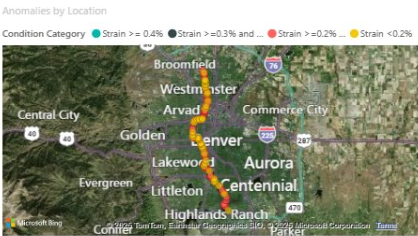
Existing strain results are mapped along the pipeline centerline and categorized by severity, making it easier to identify localized areas of concern. - External dataset integration (In Progress)
Environmental and geotechnical datasets, such as slope, seismic, soil, and weather data, can be overlaid directly onto the pipeline alignment. - Spatial intersection analysis (In Progress)
Users can identify where pipelines intersect with geohazard features, reducing the need for manual comparison across tools. - IMU data visualization (In Progress)
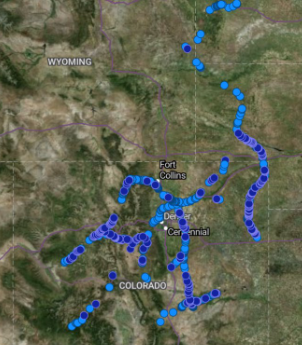
Raw inertial measurement data can be displayed along the centerline to provide insight into movement and deformation patterns.
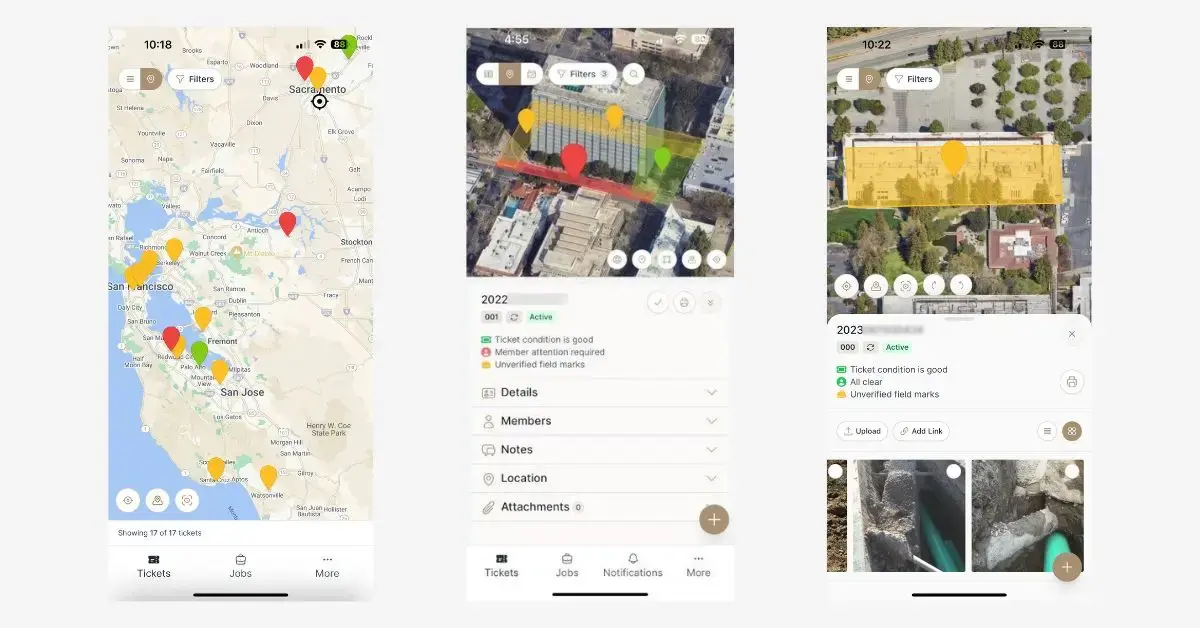
Figure 1 (Left:) ROW inspection data integration. Figure 2 (Right): Visualizing bending strain data
From Visualization to Insight (Vision)
While data integration and visualization are important first steps, the value comes from enabling engineers to answer more meaningful questions:
- Where are environmental conditions contributing to observed strain?
- Which locations show evidence of multiple interacting threats?
- How should sites be prioritized for further investigation?
Today, many of these assessments rely on manual interpretation across multiple systems. Aligning datasets within a single environment reduces that effort and improves traceability in how decisions are made.
Laying the Foundation for Interacting Threats
Geohazards rarely act in isolation. A combination of factors, such as ground movement, soil conditions, and operational stresses, often influences the identification of geohazard priority zones.
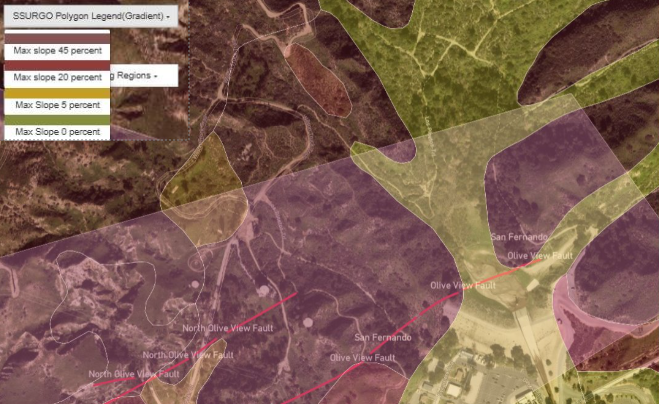
Phase I establishes the foundation for a more structured evaluation of interacting threats, in which integrity data, environmental conditions, and spatial relationships can be assessed together. A key area of focus will be identifying anomalies (corrosion, dents, cracks, etc.) in geohazard-prone areas, helping engineers better understand where environmental conditions are actively affecting the pipeline.
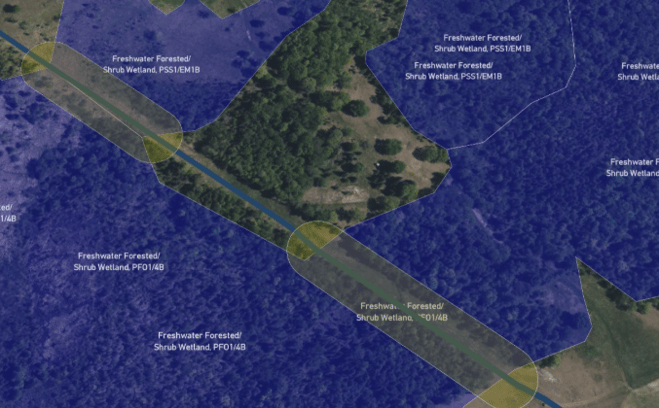
Figure 3: Visualizing geohazard-prone areas as polygons along the pipeline.
What Comes Next
With data now aligned across integrity and environmental sources, the focus shifts from visualization to more structured analysis. Future work will improve the detection of pipeline–geohazard crossings, standardize the evaluation of geohazard exposure, and support more consistent prioritization of locations for further assessment. More advanced analytical methods will be introduced where appropriate. The overall objective is to give engineers a better context for decision-making while reducing the manual effort required in the assessment process.
Building a Practical Integrity Workflow
Effective geohazard management depends on how well data fits into existing workflows across engineering, field operations, and compliance. This work focuses on creating a more connected environment in which field observations, environmental datasets, and integrity results can be reviewed together in the same spatial context. Grounding development in real operator workflows helps ensure these capabilities are practical and usable in day-to-day decision-making.
Interested in joining a Private Preview for Geohazards? Contact Us.