3 min read
External corrosion (EC) remains one of the most persistent threats to pipeline integrity. According to PHMSA data, external corrosion is responsible for nearly 20% of hazardous liquid and gas pipeline failures, costing operators an average of $500 million annually in damages and lost service.
The challenge is that a single factor doesn’t cause EC. Soil chemistry, coating quality, cathodic protection effectiveness, climate, and even microbial activity all play a role. Predictive Bayesian models can require up to 50 input variables, making prediction complex, slow, and with varying results.
The Challenge
To identify locations that are at risk of a pipeline failure due to external corrosion, operators have historically relied on:
- time-intensive multi-variable (sometimes subject matter expert-driven) predictive models which make use of data properties that most pipeline operators don't have access to, and/or
- manual alignment and analysis of inline inspection (ILI) data and close interval surveys (CIS). This approach to pipeline corrosion data collection is time-consuming, prone to error, and difficult to scale. Aligning multiple datasets to the same linear reference system is particularly challenging, leaving operators with fragmented information rather than actionable insights.
A Unified Data-Driven Framework
Data scientists at Irth Solutions have introduced a new framework (presented at Rio Pipeline 2025) that applies data science and machine learning to automatically align and process diverse datasets to highlight areas of potential active external corrosion.
- Automated Spatial Alignment – CIS, ILI, and GIS data are mapped to a unified linear reference system, ensuring multiple datasets can be correlated and analyzed properly.
- Automated CIS Analysis – Signal processing and pattern recognition extract meaningful insights, flagging low CP values, stray current pickup/drop-off, and data quality issues.
- Advanced ILI Analysis – A statistical model evaluates corrosion growth rates between inspections, identifying areas of active corrosion, not just historical damage.
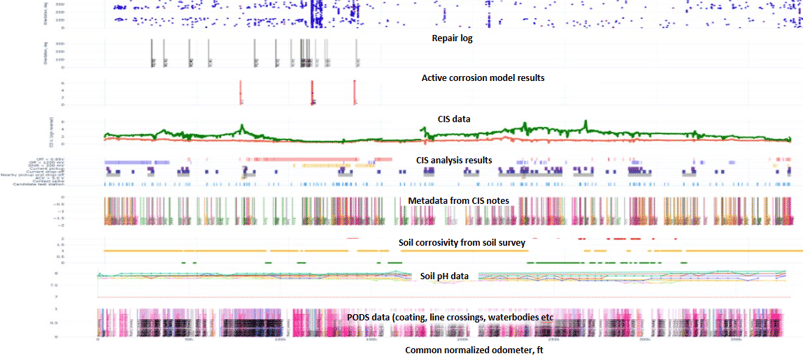
- Integrated Data View – An interactive visualization that combines ILI results, CIS analysis, soil data, repair records, and PODS attributes (millions of data points) in a common normalized odometer space.
The framework has been validated across three operators, 300 inline inspections, and more than 2,580 miles (4,000 km) of pipeline. On average, each CIS contained 70,000+ data points, which the automated framework processed with accuracy and scalability.
Building on Proven Capabilities
This framework doesn’t start from scratch; it builds upon tools already proven within Irth’s Asset Integrity for Pipelines (AIP) platform.
- The automated ILI alignment leverages AIP’s robust data mapping engine, which has been used to normalize thousands of inspection runs across operators worldwide.
- The active corrosion model is an extension of methods our data science team has already applied successfully to pinpoint areas of internal corrosion activity with high accuracy.
- And the automated CIS analysis (available within AIP’s External Corrosion module), where survey data can be validated, aligned, and assessed against integrity conditions at scale.
By integrating these tested components into a single external corrosion framework, operators can work with greater confidence, knowing the technology has already delivered results in production.
From Data Overload to Actionable Intelligence
Two case studies demonstrate the value of integration:
- In one region, densely clustered EC anomalies appeared alongside low CP shift values, a foreign line crossing, and alkaline soils. Individually, none of these factors was definitive. Together, they pointed to active corrosion that warranted closer monitoring.
- In another, stray currents induced by multiple FLCs were correlated with failing coal tar coating and CP non-compliance. The framework identified the area as a high-priority risk, enabling the operator to link anomalies with environmental stressors and historical repairs.
By synthesizing disparate inputs into a single, normalized view, the framework gives engineers more confidence in identifying where corrosion is active, why it’s occurring, and how to prioritize mitigations.
Why This Matters
For integrity teams, the ability to move from raw data to targeted decision-making is transformative. Instead of relying solely on expert interpretation of siloed datasets, operators can leverage an automated, repeatable process that surfaces regions of concern.
While the framework has been applied in the context of external corrosion, it is readily extendable to other threats such as internal corrosion, bend strain analysis using IMU data, or any other applications with pipeline inspection datasets.
The proposed framework offers an efficient, data-driven approach to EC monitoring and decision-making in pipeline integrity management. It automates the labor-intensive aspects of complex CIS data analysis to pinpoint areas of concern for expert review, establishing a foundation for future advancements in predictive maintenance and corrosion mitigation.
The result is not just efficiency, it’s better protection of critical assets. As pipelines age and datasets grow, frameworks like this set the stage for predictive maintenance strategies and data-driven prioritization.