4 min read
Integrity analytics doesn't scale without a unified inspection history.
To demonstrate what becomes possible once inspection data is aligned, normalized, and historically connected, we applied an analytical probabilistic corrosion depth model to a dataset comprised of:
- 108,000 repair records of metal loss anomalies (corrosion)
- 271 gas and liquid transmission pipelines
- Five major operators
- One-to-one anomaly chains with ≥ 3 inline inspections
to study the advantages of a probabilistic versus a deterministic approach in estimating a future corrosion depth.
Why Corrosion Forecasting Matters
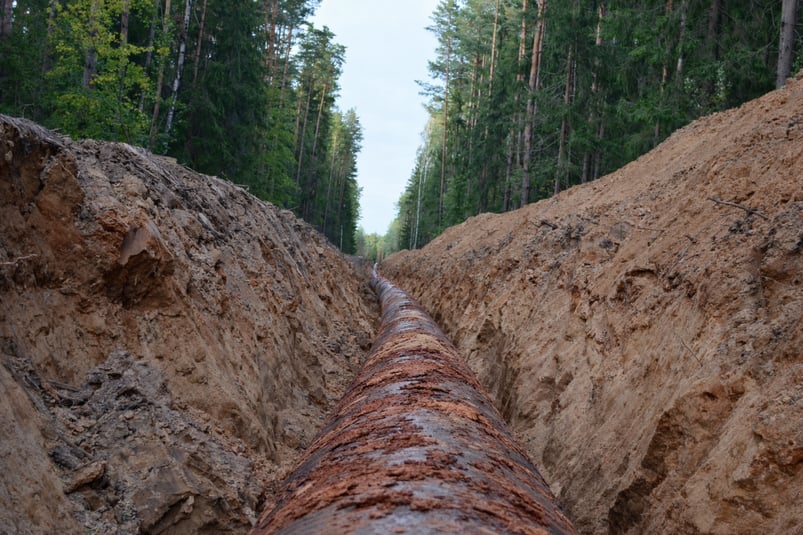
Metal loss from corrosion remains one of the dominant integrity threats to transmission pipelines. As systems age and operate under diverse environmental and operational conditions, wall loss becomes a persistent challenge. Without adequate characterization, monitoring, and forecasting, progressive corrosion can lead to loss of containment, environmental impacts, safety incidents, and significant economic consequences.
Reliable corrosion assessment and forward-looking forecasting aren't optional; they're fundamental to effective prevention of pipeline failures.
Why Probabilistic Modeling
Many corrosion growth models currently used in the industry implicitly assume that ILI depth measurements are exact. ILI systems report sizing tolerances, yet most deterministic integrity workflows:
- Treat reported depths as ground truth
- Fit one discrete growth rate to uncertain measurements
- Apply hard thresholds for repair without accounting for measurement error
This creates a fundamental problem in which uncertainty exists, but isn’t modeled.
When uncertainty is ignored:
- Growth rates can be biased
- Under-called anomalies can appear benign
- Over-called anomalies can trigger unnecessary repairs
- Automation becomes brittle and inconsistent
The probabilistic corrosion growth model was developed specifically to address this gap. Rather than smoothing or
averaging uncertain depth calls, the model explicitly incorporates ILI depth uncertainty by assuming normally distributed measurement error and propagating that uncertainty through time. The output is not one predicted depth, but a depth probability distribution and a corresponding probability of exceedance (PoE).
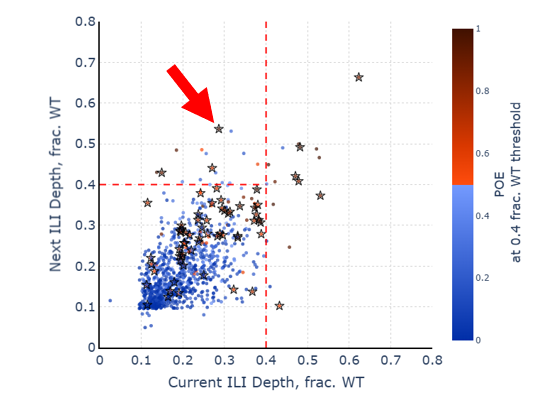
Is this outlier hiding in your dataset?
Unified Data as the Prerequisite
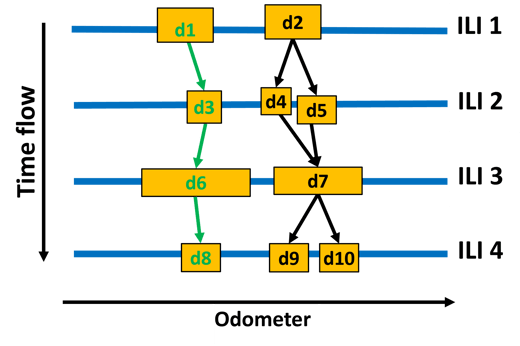
Before corrosion growth can be calculated, the same physical anomaly must be consistently identified across multiple inline inspections. This requires spatially aligned data. The automatic alignment process within AIP assigns a common normalized odometer reference to each anomaly measurement within an anomaly chain (a series of matched anomalies) across the ILI history.
Because individual odometer readings can vary slightly between inspections, each anomaly chain is represented by a mean normalized location that characterizes its position along the pipeline. This step is critical.
Only after anomaly histories are spatially aligned and normalized can depth uncertainty be modeled correctly and propagated through time. Alignment is a prerequisite for defensible analytics.
From Deterministic Depth to Probabilistic Depth
Traditional anomaly analysis for metal loss uses a fixed depth threshold. For example, "Repair if the metal loss depth exceeds 40% of the wall thickness."
However, ILI measurements carry sizing tolerances. A 38% depth "call" is not meaningfully different from 42% when uncertainty is considered.
Using unified, aligned inspection histories, the model instead generates:
- A corrosion depth probability distribution
- A corrosion growth rate (CGR) probability distribution
- A probability of exceedance (PoE) for any depth threshold
The model was first evaluated using anomalies with a field-found depth using the following thresholds:
- > 40% wall thickness (depth)
- 1% per year (CGR)
- > 50% probability of exceedance
These criteria were applied consistently across thousands of anomaly chains to identify anomalies to include in the study.
Validation Using Anomalies With Repair Data
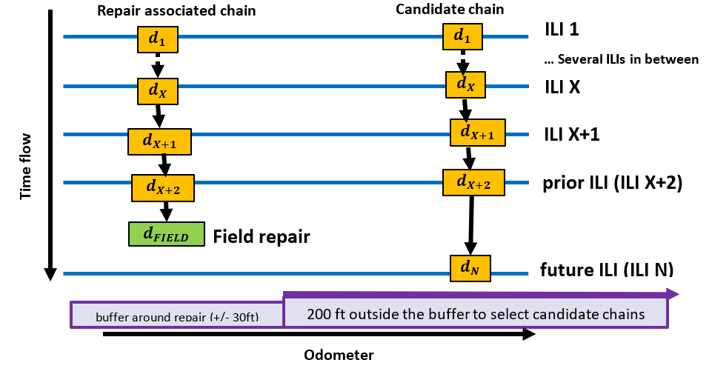
Before applying the model to candidate features, it was tested against anomalies already associated with a field-identified depth, i.e., "Repair associated chain."
Key observation: When depths were plotted on unity charts (ILI vs. a field-depth), the probabilistic approach selected anomalies distributed around the nominal 40% metal loss depth threshold. Notably:
- Several anomalies with prior ILI depths below 40% WT showed ≥ 50% PoE.
- Field measurements confirmed that some of these were, in fact, above threshold.
This demonstrates a limitation of hard cutoff screening: Features just below threshold can still carry a high probability of exceedance.
Applying the Model to Other Anomalies: Identifying Missed Risk
The model was then applied to anomaly "candidate" chains that were not repaired. These chains underwent as a subsequent ILI run that provided validation data, and therefore, the unity charts are ILI vs. ILI depth.
Example: When Ignoring Measurement Uncertainty Fails
- Prior ILI depth: 29% WT
- Reported below the 40% threshold
- Most likely not identified by repair if using a deterministic model.
But once measurement uncertainty was modeled:
- Probability of exceeding 40% WT equaled 99.7%
- Elevated corrosion growth PoE
- Feature was selected for review
The subsequent inline inspection measured the anomaly at 54% WT. The issue wasn’t necessarily growth but unmodeled uncertainty.
Across the dataset:
- 66 candidate anomalies were selected using probabilistic criteria.
- 3 anomalies fell into this critical region (Case A) where prior ILI was below the threshold, but future ILI confirmed exceedance.
- These represent the category most likely to be missed by conventional anomaly screening.
Categorizing Anomaly Risk Profiles at Scale
The model did more than identify under-calls. Selected anomalies fell into four categories:
Case A – Under-called severity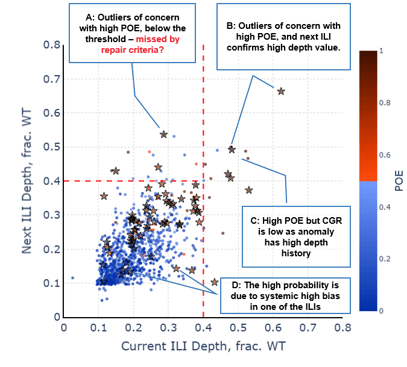
- Prior ILI below threshold
- High PoE
- Future ILI confirmed exceedance
Case B – Clear exceedance
- Both deterministic and probabilistic methods agree
Case C – High depth PoE, low growth PoE
- Elevated depth but stable corrosion growth rate
- Does not warrant immediate repair but can be managed through continued monitoring
Case D – Measurement bias
- High PoE driven by outlier measurement
- Future ILI did not corroborate
This differentiation matters because deterministic screening cannot distinguish between:
- True high growth
- Stable deep corrosion
- Measurement bias
Probabilistic modeling can.
Why This Scales
The model requires only:
- Historical ILI depths
- Inspection timestamps
- Tool sizing tolerances
Because inspection histories were unified and aligned, the same statistical framework was applied across:
- 271 pipelines
- Tens of thousands of anomaly chains
The Strategic Implication
Automation in integrity programs is not about dashboards or AI overlays. It begins with unified inspection data, from which data science models can be derived and tested. This is the bridge between unified data and engineering-grade AI.
Learn More
Two liquid pipeline operators have commissioned controlled studies applying the model to their historical ILI portfolios to quantify performance against existing Integrity management screening practices.
These studies require only:
- Historical ILI depth data
- Inspection timestamps
- Tool sizing tolerances
For operators seeking to strengthen statistical defensibility in corrosion decision-making, an analytical study may provide measurable insight before broader implementation.