3 min read
An underground utility is damaged every 2 minutes and 40 seconds in North America. Since those are just the incidents reported to Common Ground Alliance’s DIRT system, the number is higher.
At the same time, more than 100 million excavations happen every year — roughly three new jobs begin every second, including nights, weekends, and holidays.
While excavations continue to scale, resources do not.
No utility has unlimited locators. No organization has endless screening staff. No damage prevention team has enough time to personally evaluate every ticket with the same level of scrutiny.
That’s what makes Common Ground Alliance’s 50-in-5, reducing damages by 50% in 5 years, a significant challenge — without AI.
AI can help prioritize the riskiest tickets, so the right action is taken by the right people at the right time to avoid damage.
AI Projects Don’t Fail Because of the Technology
Despite the promise and enthusiasm for AI, 95% of AI pilots fail to deliver meaningful results, according to an MIT study.
In most industries, a failure rate that high would kill the category. Instead, AI investment keeps increasing, fueled by the belief that the technology will be the answer. When the results don’t match expectations, the AI models get blamed.
But AI projects often fail because organizations treat AI as software deployment rather than an operating model change.
A team builds a prediction model. A dashboard gets launched. Some automation gets introduced. Then everyone waits for the transformation.
But prediction alone does not reduce damages.
Outcomes only improve when predictions change decisions, decisions change actions, and those actions are continuously measured and refined.
That operating loop is where many organizations struggle.
How to Succeed with AI
Successful AI implementations tend to follow the same blueprint:
- Pick One Use Case
When an organization doesn’t define an objective, picks too many, or chooses the wrong one, their project fails. The right approach is to pick one operational outcome you actually care about to improve, in plain language, before you look at a single data point. - Secure Executive Buy-in
Meaningful AI adoption requires resources, cross-functional cooperation, and tolerance for the iterative messiness that comes before results stabilize. Without a clear mandate from leadership, every friction point — a resistant team, an ambiguous decision, a result that looks wrong before it makes sense — becomes a reason to quit. - Define Measurable KPIs
After you select a use case, ask whether you can measure it. If you can’t measure it directly, get as close as you can — and be honest about the gap. Choose two to three KPIs tied to operations, such as damages per 1,000 tickets, screening rate, time-to-screen, etc., keeping in mind, “model accuracy is not a business metric.” - Identify Usable Labels and Data Gaps Early
Appropriate labels, such as damages, high-cost incidents, safety-critical events, near-misses, etc., allow data to be useful by the AI model. - Spike (Go/No-Go Feasibility Test)
This step is an offline, time-boxed feasibility test when you ask the question, “Can we predict something actionable with the available data?” The answer determines if you proceed, pivot, or stop. - Small Wins Build Trust
The organizations seeing measurable success begin with a single workflow, geography, or operational bottleneck. They test interventions. They measure outcomes. They refine the model. Then they expand. That discipline matters because AI systems rarely succeed perfectly on the first iteration. The organizations that scale responsibly learn faster — and waste less. - Build to Grow
Since conditions change, models must be managed. This continuous testing, drift monitoring, and retraining cadence creates a scalable infrastructure. - Showcase the Story
Share the story of your AI success to internal operations staff and executives as well as externally through case studies, proof points, and repeatable playbooks. This showcase creates the “permission to expand” required for budget and full-scale adoption of AI.
The Shift from Equal Treatment to Risk-Based Operations
Historically, many damage prevention workflows were designed around consistency: every ticket processed similarly, every request moving through largely standardized procedures.
But scale has changed the economics of that model.
When incidents occur at roughly a one-in-a-thousand rate, the question becomes less about processing every ticket identically and more about identifying the small percentage of excavations most likely to create serious consequences.
That’s where risk-based operating models become transformative.
Instead of spreading scarce resources evenly across all activity, organizations can direct the highest levels of intervention toward the excavations with the greatest likelihood — or impact — of damage.
That intervention may include:
- Proactive outreach
- Additional QA reviews
- Photo audits
- Standby support
- Watch-and-protects
- Field escalation
- Intelligent dispatch prioritization
At the same time, lower-risk activities can move through increasingly automated workflows with confidence.
The industry is beginning to see measurable evidence that this approach works.
Organizations deploying AI-driven screening, risk scoring, and workflow automation are already reporting significant reductions in damage rates, improved operational efficiency, and faster response allocation.
In some implementations, AI-assisted workflows have reduced incident likelihood dramatically for the tickets touched by those systems while simultaneously lowering operational costs.
The Challenge Ahead
The challenge behind the CGA’s 50-in-5 initiative is real. Reducing damages at industry scale is extraordinarily difficult. But they’re also precisely the conditions under which AI delivers the most value — ranking millions of excavation tickets by risk, surfacing the 8% that account for half of all incidents, and directing the limited human attention that exists toward the places it matters most.
The technology can do this. It’s doing it today, in production, at organizations that got the organizational side right.
The question for every executive considering an AI initiative — in damage prevention or anywhere else — isn’t whether the technology works. It’s whether your organization is ready to operate it. That means aligned leadership, a sharp objective, disciplined iteration, and genuine accountability for outcomes.
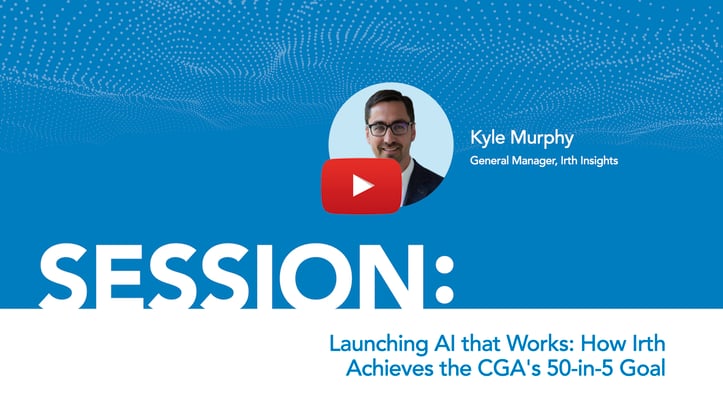
To learn more about launching AI that works, tune in to the entire CGA presentation today.