5 min read
Is CGA’s 50 in 5 on Track? A Candid Look at Damage Prevention’s Biggest Challenges
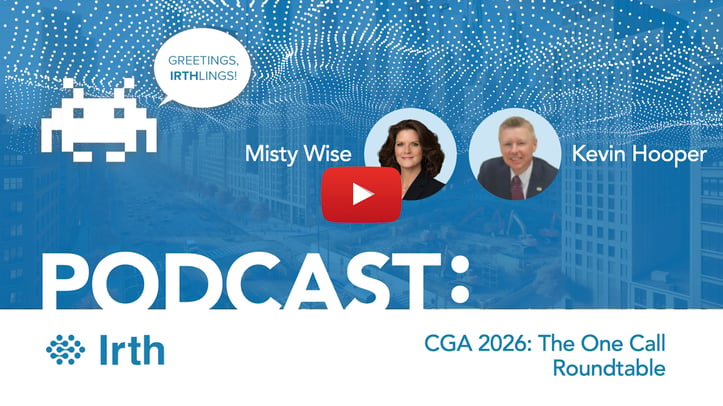
The following is adapted from a conversation recorded at the 2026 CGA Conference & Expo for the Irth Podcast, featuring Misty Wise, Executive Director of South Carolina 811 and CGA Board Member, and Kevin Hopper, Executive Director of UDig New York and Vice Chairman of the Common Ground Alliance Board of Directors.
Let’s start with the big one. We’re several years into the CGA’s 50 in 5 initiative to reduce damages by 50% in five years. How are we doing?
Wise: Collectively, I don’t think we’re super happy about where we are. There’s still a tremendous amount of work to do to get back on track.
Hopper: 50 in 5 has done some good things. It definitely got the conversation started and challenged the industry to do something. But a challenge without guidance on how to meet it only goes so far.
Where does the one call center fit into all of this? You’re the communication hub, but you’re not the ones submitting the excavation requests or swinging the shovels.
Hopper: We play a vital role, but at the end of the day, it’s not something that can be solved alone. Damage prevention requires all stakeholders to come to the plate. The one call centers have to challenge each other, and step up to try to address the challenges to support those folks. We’re really good at bringing people together to collaborate, but we also need to adapt. We can’t just continue to do the same things that we’re doing.
Wise: Some of our peer groups have taken some pretty big strides to try to move the needle, but there’s a lot of laggards in what that looks like. We’re trying to get some of the groups up to the same level and really addressing that at the board level. It really comes back to the states. I feel like it’s a stop gate. We’ve got to be able to push the needle on each of our levels in each of those states to be able to see the collective rise to 50 in 5.
Hopper: 811 has become shorthand for the entire damage prevention process, but it’s really just one piece of a much larger system. The one call center coordinates where information gets processed and sent, but there’s a whole bunch of other things that have to happen correctly in the system for it work. At the end of the day, it really takes everybody willing to give something. We can’t just keep taking from the system and expect a different result.
What’s changed over the last 15 years in damage prevention?
Wise: Technology. Technology is moving faster than people’s mindsets can. That’s the struggle, right? You have to be able to change people’s mindsets and how they utilize the tools to benefit the rest of the industry.
Hopper: Everything that could make this process better is already available. The problem is that we need people willing to adopt the technology and change. Until we’re willing to say, “I might have to give up something to fix it,” to save lives and make this process better, we’re going to continue to cycle.
Wise: Our industry is driven by money at the end of the day. When it comes to the CEO and C-suite level, the struggle is always going to come down to a financial gain or loss. That definitely takes away from the mission that we have to keep people safe.
What would you say directly to the excavating community if you had the chance?
Hopper: I understand where they sit as the last piece in the channel. At the end of the day, we’re all damage prevention. It’s a shared responsibility.
Understand how your behavior affects the whole system. An excavator flooding the queue with 500 tickets in a month might be doing what makes sense for their business — but every other excavator is trying to do the same thing, and the system can’t absorb it without consequences downstream.
We’re approaching the 20-year anniversary of the 811 system, and awareness is no longer the problem — participation and shared responsibility are.
Be engaged, understand the process, and play in the sandbox with your neighbors in mind.
And for the facility owner and operator community?
Wise: Take ownership of your work from the very beginning. Even though a lot of these operators are handing off work to other groups, they are actually the cog that starts the wheel in a lot of cases. Roughly 60% of active tickets in some states are driven by utility or infrastructure work done on behalf of operators. And yet, operators frequently hand off projects without giving any advance visibility to the locators and excavators who need to plan for that work.
When forecasting doesn’t happen, locators can’t staff appropriately, excavators can’t schedule accurately, and the whole chain breaks down. The tools exist to share that visibility. Use them. Passing the problem downstream doesn’t make it disappear — it just makes everyone else’s job harder.
Hopper: This also varies significantly by type of operator. What you’d ask of a gas utility is different from what you’d ask of a broadband provider. Many rural broadband companies receiving federal funding right now have no idea what long-term locating participation in the one call system actually requires.
Contract locators have been under a lot of pressure. What’s the ask there?
Wise: The contract locate community is caught in a race to the bottom on pricing, and it’s undermining safety. Operators put bids out and award to the lowest number, locators accept knowing the rate isn’t sustainable.
If contract locators collectively refused to accept bids that don’t reflect the actual cost of doing the work safely — and did so as an industry — it would force a reset on how those contracts are structured. That’s unlikely to happen, but the principle matters: the integrity of the locate shouldn’t be the thing that absorbs the margin pressure.
Hopper: From my standpoint, it’s going back to a basic framework. Locating needs to become less of an output and more of something that ends up with the result as intended.
There’s been significant discussion around the NUCA paper at this year’s CGA Conference. What are your thoughts?
Hopper: The paper raised real issues, and the conversation it started is valuable. We still need action.
Wise: One of the things they addressed was ensuring that we had locator and excavator representation on boards. I do think that’s a big deal. It’s difficult to get everyone on the same page at the same time.
Hopper: The reason the one call center exists is to make it so all stakeholders can participate and that we have a process that works for everybody.
Final question: What keeps you engaged with this industry after so many years?
Hopper: CGA is the place where all the stakeholders get together, share ideas, and challenge others to do better. At the conference, you can walk the expo floor, have a side conversation, and hear someone say, “They’re doing that in that state — why aren’t we doing it here?” That’s the best thing that can happen for the industry.
We want to see action, but we identify what works by using data to tell the story.
Wise: I want to make an impact, and I feel like CGA is the place to try to make that impact. We’re each doing it at the state level to the best of our ability, but this is the playground where we all come together to try to figure out what that looks like. I’m very passionate about what that is, especially since I’ve seen the bad that can come from not doing it the right way from all sides from a locator to an operator to an excavator.