3 min read

Stake Center: 8 Lessons Learned Implementing 811 Ticket Risk Screening & Clearing with Irth Insights
When Stake Center set out to improve efficiency and reduce excavation damages, the goal wasn’t to deploy artificial intelligence for the sake of innovation. The objective was far more practical: manage overwhelming locate volumes, prioritize risk, and protect critical infrastructure.
What followed was a year-long learning journey using Irth Insights — one that delivered measurable results, including a 20% increase in field locate efficiency and a reduction in excavation damages, but also surfaced important lessons the industry can learn from.
Stake Center shared what worked and what didn’t at User Summit 2025. This is their story, and other lessons discussed in the session.
Lesson 1: Efficiency Gains Are Real — But Only When Risk Comes First
The 20% improvement in locate efficiency did not come from simply clearing more tickets automatically. It came from reordering priorities around risk.
Stake Center knew risk must override clearing decisions. If a ticket crossed a defined risk threshold, it didn’t matter how “clearable” it appeared — boots on the ground were required.
Irth Insights identifies 50% of damages in the top 8% of tickets.
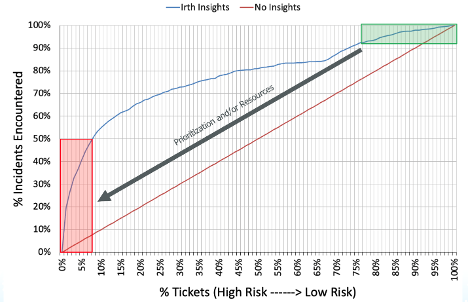
This knowledge shaped how the system was configured:
- High-risk tickets, such as those identified as a top 8% damage risk, were dispatched immediately to the field
- Low-risk, highly clearable tickets were handled in-office
- Ambiguous tickets were routed for human review
Key takeaway: AI should not replace judgment. Risk-first logic prevents efficiency gains from turning into safety liabilities.
Lesson 2: Not All Tickets Deserve Equal Human Attention
Before implementation, human screeners spent valuable time reviewing both:
- Tickets that were almost certainly safe to clear
- Tickets that were almost certainly high-risk
Irth Insights exposed the inefficiency of this approach.
By stacking risk and clearing models together, Stake Center learned to:
- Remove the highest-risk tickets from human screening entirely and send them straight to experienced locators
- Stop wasting human review on tickets that were highly likely to clear
- Focus human judgment where it mattered most
Lesson learned: The real efficiency gain was better allocation of human expertise.
Lesson 3: AI Scores Don't Change Outcomes — Behavior Does
One of the most important realizations was that scores alone don’t reduce risk.
A risk score on a ticket doesn’t prevent damage unless it:
- Changes who works the ticket
- Changes how quickly it’s addressed
- Changes how it’s audited
Stake Center used risk scores to:
- Assign high-risk tickets to more experienced locators
- Direct auditors toward higher-risk work
- Prevent newer locators from being assigned to complex or sensitive tickets
Lesson learned: AI delivers value when it is embedded into workflows that actively drive change in the field.
Lesson 4: Thresholds Must Be Adjusted
One of the early learnings was understanding that clearing and risk thresholds can’t be “set and forget” it.
Models retrain frequently as new data flows in, and risk and clearing behavior shift over time by state, by excavator, by season.
Stake Center learned the importance of:
- Reviewing smart scores every 2–3 weeks
- Adjusting the clearing tolerance as model confidence evolved
- Recognizing that risk appetite may change month to month
Lesson learned: Successful AI programs require operational ownership. Someone must actively manage the system, not just deploy it.
Lesson 5: Explainability Builds Trust Faster Than Accuracy Alone
Explainability becomes critical when there is skepticism about AI.
When users could see:
- Why a ticket scored high risk
- Why clearing was recommended or blocked
- What specific factors influenced the score
…confidence increased dramatically.
This transparency allowed teams to:
- Validate unexpected results
- Catch edge cases early
- Correct operational or data issues before they scaled
Lesson learned: Trust in AI comes from understanding.
Lesson 6: Models Can Learn Bad Behavior from Humans
If tickets were repeatedly “cleared” incorrectly by people in the field, for example, the model learns that behavior — sometimes to the frustration of excavators and operators.
This can be addressed by:
- Excluding emergency, no-show, and short-notice tickets from learning
- Using smart scoring to immediately block specific excavators or work types
- Adding manual controls to override model learning when patterns emerged faster than retraining cycles
Lesson learned: Bad habits scale quickly if left unchecked. It comes down to consistent and accurate data collection.
Lesson 7: Clearing Should be Scoped — Not Universal
Stake Center limited clearing automation to fiber tickets only.
By scoping one use case, they were able to:
- Build confidence incrementally
- Avoid overexposing critical assets
- Learn where automation made sense — and where it didn’t
Lesson learned: Start narrow. Prove value in a controlled environment before expanding.
Lesson 8: Workforce Impacts Matter
A 20% efficiency gain changed the workforce equation.
Stake Center learned that:
- Clearing more tickets upstream changed the locator incentive structures
- Efficiency gains helped support longer-term, more stable locator careers
Rather than increasing pressure, efficiency helped reduce turnover, one of the industry’s most persistent challenges.
Lesson learned: There are multiple metrics for success when implementing Irth Insights.
AI Is the Future — But Only With Intentional Design
Stake Center’s experience reinforced a critical truth for the industry:
AI is inevitable — but results are not.
The gains came not from technology alone, but from:
- Clear risk governance
- Thoughtful workflow integration
- Continuous tuning
- Willingness to change long-standing practices
For organizations considering AI-driven risk and clearing, the biggest lesson is this:
The value isn’t in automating decisions — it’s in making better ones, faster, with the right people involved at the right time.
That’s where the real efficiency — and safety — are realized.
Check out the full session
To better understand how Irth Insights can enable your team to reduce damages, improve safety, and increase efficiency, schedule a demo today.