
Case Study
Beyond the Detection Threshold
Catching Bottomside Pipeline Corrosion Before it Becomes a Release
Key Results
82% average ranking performance
cross 9 confirmed release locations spanning 8 pipelines and 3 operators, with a perfect ranking score on two pipelines.
Validated on unseen data
Correctly identified one of two releases on a new pipeline's first pass, then both after retuning.
No new data collection required
Built entirely on ILI anomaly data and elevation profiles already available to operators.
Context
Already using Irth's Asset Integrity for Pipelines (AIP) platform for inline inspection (ILI) data management and analysis
Wanted to turn existing ILI data into a proactive, predictive view of release risk, rather than reacting only after the next inspection or incident.
Challenges
- Bottom-side internal corrosion forms small, deep pinhole pits that often fall below ILI tools' reliable detection thresholds
- No standardized way to combine relevant risk signals, pinhole concentration, depth outliers, active corrosion, valley location, and orientation across a large network
- Full theoretical chemical and microbiological corrosion models require operational data most operators don't have
- Maintenance prioritization tended to be reactive, following known anomalies instead of anticipating where the next release was most likely
Solution
Development of Irth's data-driven Internal Corrosion (IC) Susceptibility Model
Identifies the pipeline locations with the highest probability of a bottom-side corrosion release, using ILI anomaly data and elevation profiles the operator already had
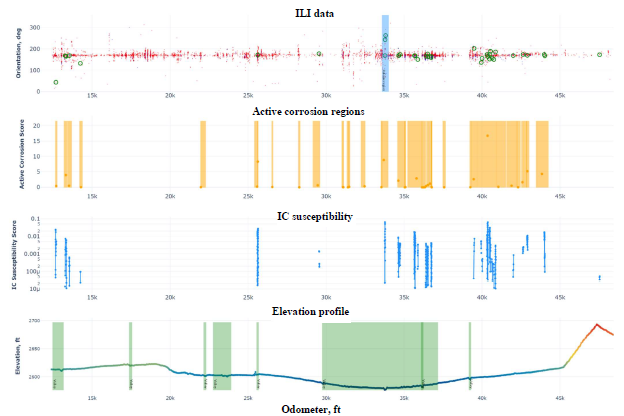
“Where a single pinhole measured at just 17% wall thickness went undetected until a release occurred, Irth's model would have flagged the surrounding region as high-risk.”